Tuesday, October 21st, 2008

Sickness in Goa, Sickness in Bengaluru, India

On Thursday, J. and I boarded a day train for the 12 hour trip to coastal Goa. We shared a four bunk cabin with a man that slept the whole time and another who was part of a large group of pharmaceutical workers on a business retreat. The cabin behind us was their party headquarters. They sang and played games and chatted loudly for the whole ride.

The 2nd Class AC aisle: two bunk compartments in a narrow space on the left, 4 bunk rooms on the right.
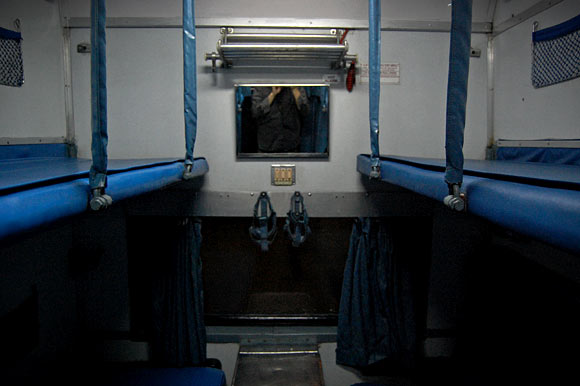
4 bunks.
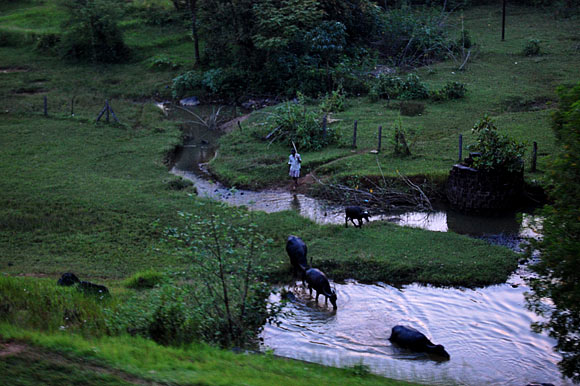
Man and buffalo outside the train in Goa.
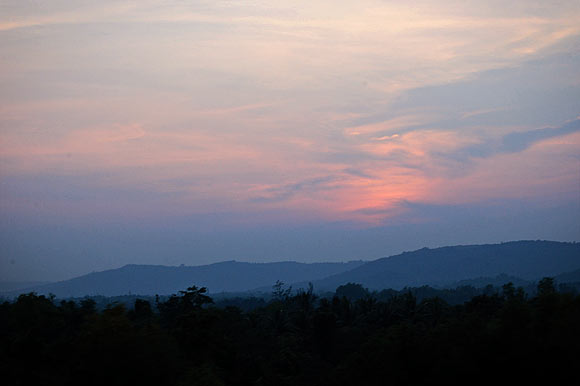
Train sunset.

We arrived in Margao, Goa around 9PM and took a prepaid taxi the 6km to the small coastal town called Colva. We deliberated about the best beach to stay at, and Colva seemed a good combination of convenience and location. We pulled up to Lucky Star Hotel around 9:30 or ten and I said to the cabbie “yo holmes smell you later.” After checking in to a cheap, 300Rs a night room, we walked to the nearly empty restaurant and ordered dinner. Mistake. I ordered the Goan-style egg curry. Mistake. We ate and went to sleep.

Early in the morning I woke up with bad gas and couldn’t fall asleep again. Then I got up from bed and surprised myself by vomiting in the shower. I hadn’t been sick this way since childhood; much like Jerry I had a great streak ruined by one bad meal. J. did not get sick.

To make matters worse, I had also started getting congestion and a sore throat on the train. The stomach sickness seemed to aggravate it. Before noon, we moved down the road to a more upscale (though mildewed) hotel and I rested for the day.

The next day I felt good enough to go for a walk along the beach and to get coffee. I had a pounding headache from caffeine withdrawal thanks to the plentiful cups we sipped in Mumbai. The beach was pretty nice, with clean sand and coconut palms. Most of the shore was developed with fishing village huts. The main town was only a street, but it had everything a traveler needed, including an excess of Kashmir and Tibetan handicrafts. The tourists were mostly Indian.
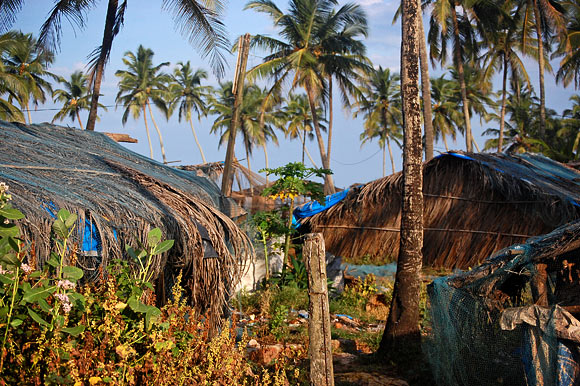
Fishering huts on the beach.
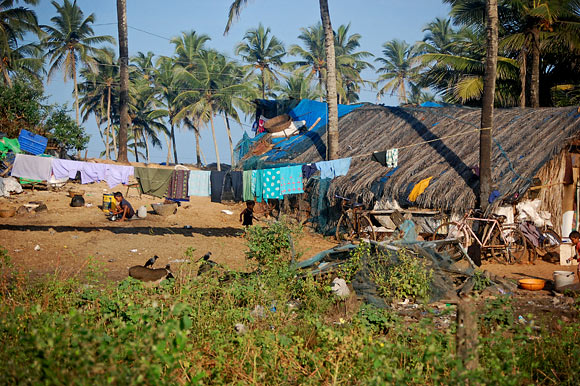
More huts.
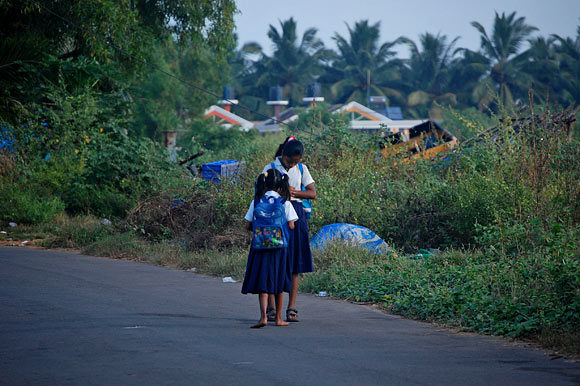
Kids walking to school.
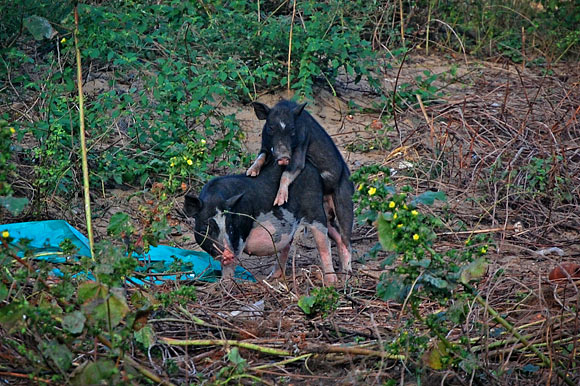
Pigs humping.
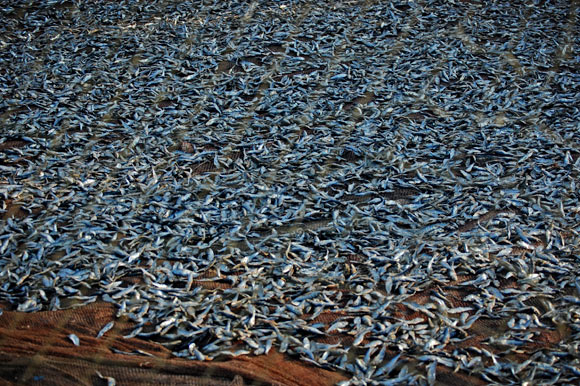
Small fish drying in netted enclosures.
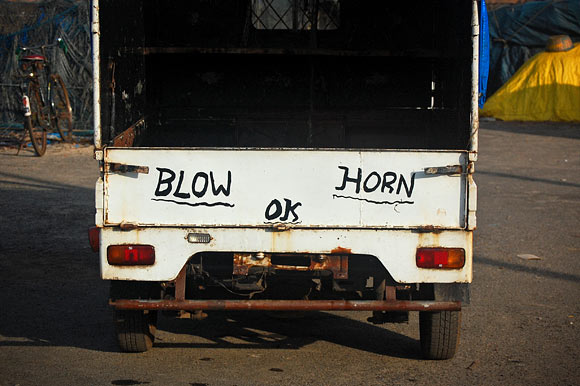
Fish delivery truck.

Colva Beach, Goa.
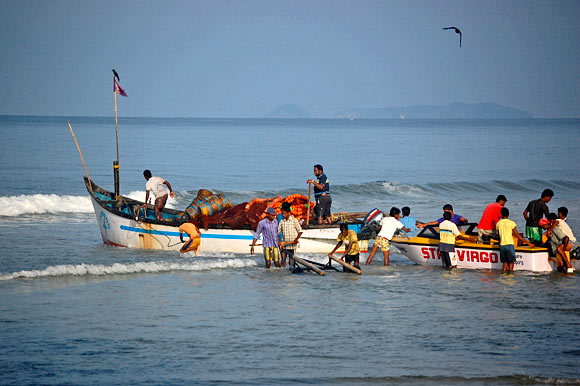
Fishermen bringing in the catch.
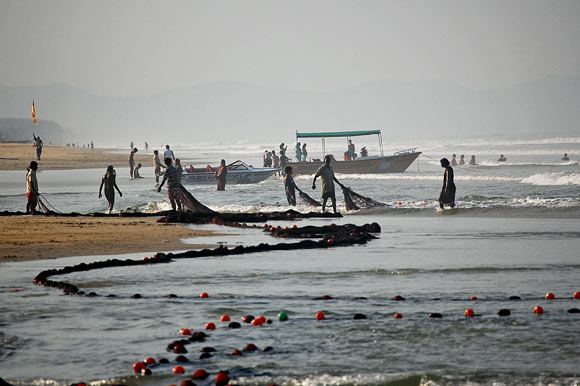
More fishermen bringing in the catch. This massive net was full of fish.
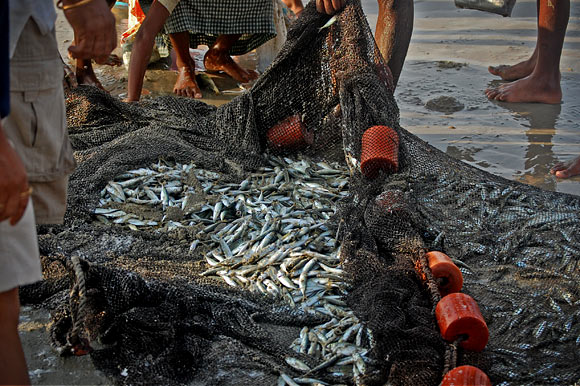
Fish.
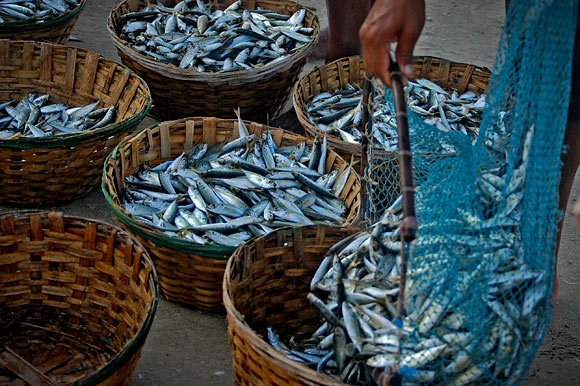
Fish getting sorted. There was another basket for squid.
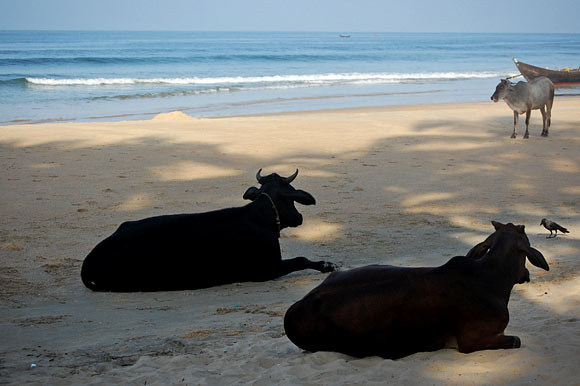
Cows lounging on the beach.
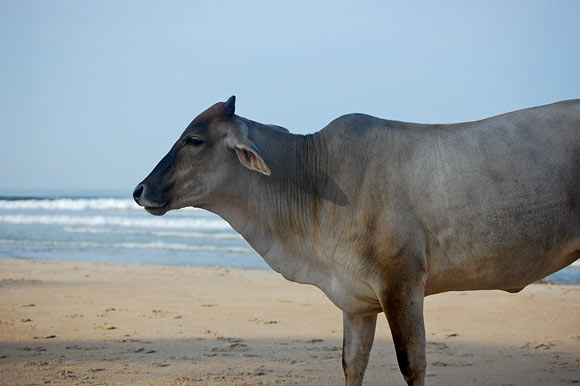
Dylan McCow is so cool.
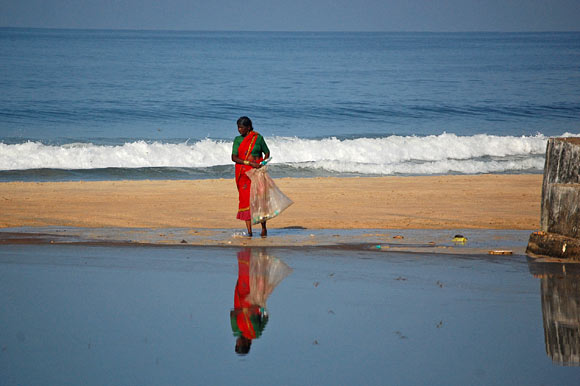
Woman and water.
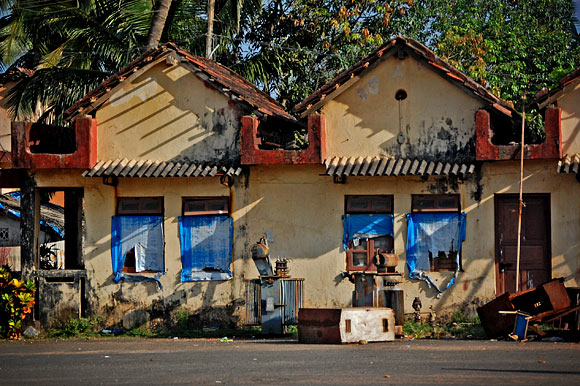
Defunct businesses.

After the walk it was back to the room for hours of rest. I went with J. to dinner but was feeling sick just looking at the food. I got a lime soda and a few bites of bread. A small bottle of Benadryl was purchased for less than a dollar to help my congestion and coughing. That evening I went to bed at 7:30.

Saturday I was still feeling crappy so I rested most of the day. By lunch my appetite had come back a little so we hung out a hygienic-looking “British-owned” pub called Tates. I got fish and chips and J. got jumbo prawns. We sat for three hours eating and playing cards. I went back to rest. In the evening, we headed to the beach to watch the sun go down. Storm clouds rolled, we ran for shelter, it poured, and the sky cleared just in time.
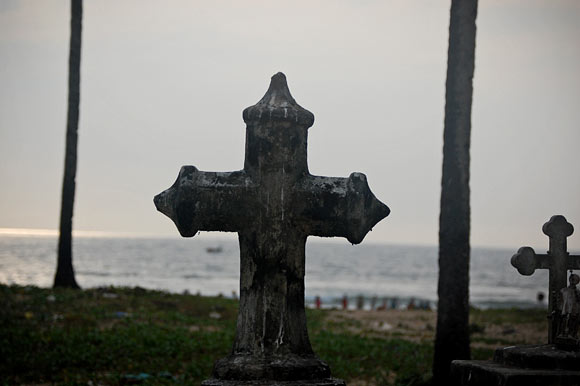
Crosses.
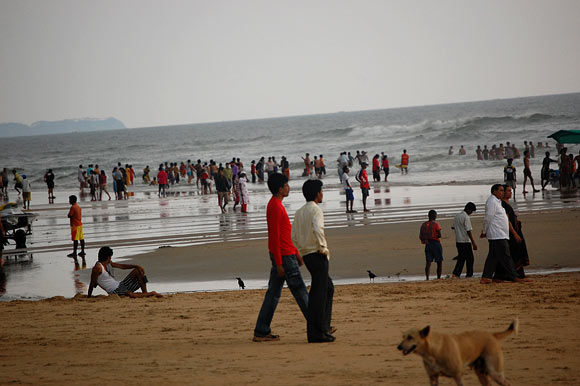
Crowds gathering for sunset.
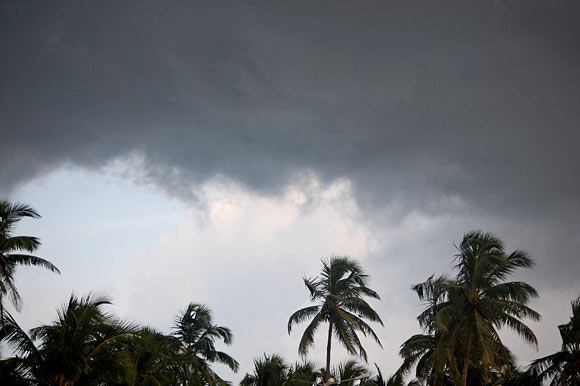
Clouds gathering for sunset.
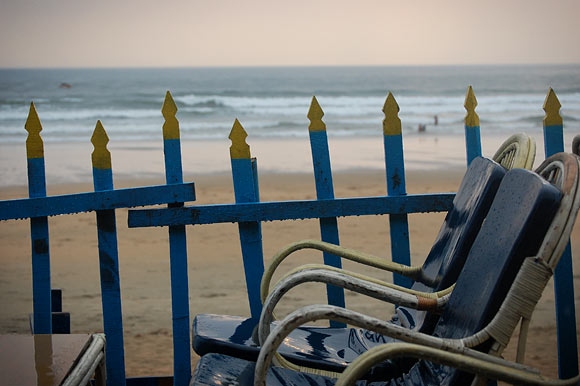
Our storm shelter.
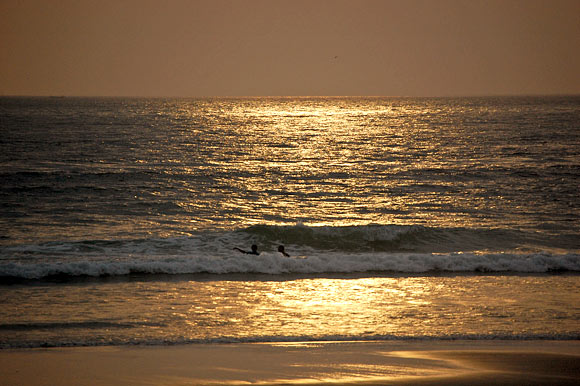
Sunset.

We left Goa on Sunday. We didn’t get to do much of what I’d hoped: rent a motorbike and explore, try out the local cuisine, relax on the beach. I had slept for most of the stay, and by the time we boarded our flight I was starving. I realized then that in three days I had only eaten two meals, one of which I lost. Fortunately, despite all the local news of layoffs and cost cutting, Kingfisher Airlines served a great vegetarian meal on the one hour flight to Bengaluru (Bengalore).

Did you know that the name Bengaluru literally means “the town of baked beans”? It’s a weird historical juxtaposition to its current claim of technology outsourcing mecca.

Did you know that in our first day in Bengaluru we got food poisoning again? This time the culprit was a friendly, dosa-serving place we went to dinner. Just when my gut was calming down, it got tweaked again. J. wasn’t so lucky and for most of Monday has been in the bathroom or bed. Our one full day of exploration has been turned into one full day of burping, pooping, vomiting, and bed rest.

I think India has planned this all along. As soon as a visitor starts getting comfortable here, it needs to throw a little reality check. Reading the papers here reveals the constant potential for craziness at any moment. In a country where bombs blow, people riot, rape, stone, and crash, at little sickness from ill-prepared food seems pretty minor.

I’m looking forward to Thai food.

Friday, October 17th, 2008

Three Days in Bustling Mumbai, India

Note: I will try to keep brief what would otherwise be a sprawling and verbose entry.

Our trip to Mumbai, India began with a terrifying and exhausting 16 hour overnight bus ride from Udairpur. The bus was an older Volvo air conditioned semi-sleeper, meaning the seats reclined but would never be considered beds. During the daylight hours the ride was pleasant enough, but as sun fell things got scarier. The winding roads to lower elevation were taken with speedy abandon. At many points, the bus leaned so much I feared it would tip over. The driver passed sleepy cargo trucks with honks and inches to spare. I drifted off to sleep a few times only to be awoken by dreams of bus crashes or the rumble and violent bumps of a bad stretch of road. The bus stopped a few times for potty and snack breaks. Never before have I smelled such a strong concentration of pee. The men’s stalls were like standing at the precipice to hell.

Day One

I must have slept a little, because I awoke as we entered the outskirts of Mumbai. Like Los Angeles, the edge of the city was sprawling and undefined. But as my eyes fluttered open I saw we were there: slums, pollution, modern buildings, density, wealth. The highway was in shambles and the bus bounded and rumbled over the road dramatically to our stop. We hopped in an old taxi and headed to find a guesthouse.

It was early morning. We had the driver drop us off at a landmark in the Colaba area called Gateway of India. This arch was built by the British, and it stands under renovation at the water’s edge of Mumbai Harbor. The first places we looked were dumps. We eventually found the cheapest room in a recommended guest house called Bentley’s. We are on the ground floor on the backside of the building, separate from all other rooms and next to the kitchen. The room is a pricey 1095Rs($23) a night, but considering the musky 500Rs rooms we looked at had shared bathrooms and looked to be in a converted 1940s cubicle office, our new find was worth it. Plus, it had complimentary tea/coffee and toast.

First, we took showers and a nap. Then we went in search of food and a Bollywood movie.

Gateway of India.

Mumbai taxis are everywhere. There are 50,000 of them in the city, all based on a 1950s Fiat.

Unlike the rest of India, the taxis here are metered. The device is mounted on the exterior and functions as a for hire indicator as well. The meter can be read through the window. As they are so old, the fare is calculated by multiplying the reading by about 30. Inflation at work.

Two delicious, plate sized dosas from a wonderful restaurant in Colaba called Laxmi Villas.

What a load of business.

We sat and watched impromptu games of cricket in Oval Maidan Park until shoe shine and drum selling kids started annoying us.

Detail of the High Court building. Castle-like. We checked our cameras and walked around the halls, peeking into trials and brushing robes with judges.

Sidewalk used book seller displays his wares under a shade tarp. There were used books for sale all over town, as well as all other kinds of merchandise.

Dhaba-Wallas at work. The city has 5,000 such people that deliver lunches using a color and pattern coded system of containers. Lunch boxes are picked up from homes and restaurants, sent to a sorting facility, and delivered by hand around town. Each day, 200,000 meals make it to their intended stomachs. Amazing.

Mumbai was the first cosmopolitan feeling city we’ve been in India. It’s a cross between London, Los Angeles, and India. All over was rushing traffic, pedestrians, and sidewalk hubbub. Numerous coffee shops and a wide variety of good restaurants are supplemented by high turnover street foods. There are a lot of cars in the town, mostly taxis, and barely any auto rickshaws or motorbikes. Fancy cars are not an uncommon sight. If it weren’t for the garbage, noise, and masses of Indians it could be any other country’s metropolis.

We bought two, 100Rs($2) balcony tickets to a popular Bollywood release called Hello. Spoiler alert: the movie sucks. It’s based on the popular book One Night @ The Call Center, but it took many maddening liberties. My brain has a hard time processing how weird and bad this movie was, but I’ll try.

Hello is a story within a story. It starts with a poppy shirtless rock-styled song and dance number by Bollywood star Salman Khan. Afterwards, as he’s waiting for his chopper. A woman (who turns out to be an angel) tells him the story of what happened to a group of sophomoric idiots one night at a call center. Basically: they dilly dally, flirt, have personal problems, and get a call from God on a Nokia phone.

The priorities and purpose of the film was all over the map. The mood went from joking to serious and back again without any reason. A man would crack a joke and then some lady would find out her husband was having an affair, or a man would get an email from his son saying he never wanted to see him, etc. All of these seemingly profound problems were treated as tear jerkers but had no bearing on the plot. There was a sitting on the shoulder type devil version of the protagonist (with imperfect compositing). There were a few song and dance numbers that didn’t integrate. Love story. The call center was run by a sycophantic manager who bowed to his Boston-based boss (who had an British accent). All references to America painted us as idiots. Occasionally there were vignettes showing Americans calling with various problems. The people cast were so obviously non-American as to be laughable. They were all white, but their English was so bad it sounded like a bunch of retarded Estonian hookers. The movie was mostly in Hindi, but lots of lines were in English also. The dialogue flowed between both languages and greatly helped comprehension. It felt like I had a babbelfish in my ear. Not that there was anything worth understanding. The characters didn’t grow and their goals remained selfish. The call from God was in Hindi, so I don’t know what he said. But it was tacked on too late to matter anyway. It was a harsh movie, and poorly done. It ended with the protagonist marrying the woman you thought he was going to lose to a rich man (who worked for Microsoft). The boyish, now successful, protagonist presents her with a new, gleaming white Honda SUV. They embrace. Dreams come true after all.

I hope not all Bollywood films are this bad.

Day Two

Our second day in Mumbai was mostly a hot, 7 hour death march across town. I had wanted to see the Parsi Tower of Silence, a temple where people of the Parsi faith leave their dead to get eaten by vultures. Rather than take a taxi or train, we walked. And walked. For some reason, I always find myself leading J. on these epic, uncomfortable walks.

We started in Colaba and ended up as far north as Haji Ali’s Mosque. The streets were busy, the beach was hot, the walk was long. By lunch time, I was soaked with sweat. By evening, I had visible salt deposits over my shirt. We had seen and sweated over a lot of town. It was a good day. The guard wouldn’t let us in the Parsi grounds. I should have brought my vulture costume with me.

Mumbai stock exchange building. People were outside watching the marque.

All over town are fresh sugar cane juice stands. They have cane all around them and extract the juice on the spot. A half glass is 4Rs and surprisingly green and refreshing.

Food delivery scooters.

Many of the food stalls and some of the restaurants get clean water delivered via truck or these hand carts.

Scooter and sidecar.

Street.

Man cracking nuts on the street.

Man delivering sugar cane with an ox driven cart.

Smart cards available from inside this black void near the train station.

The beautiful and massive Victoria Terminus building. Inside were swarms of people coming to work during the morning rush hour.

Across the street was another old building.

Men with typewriters on the street. There were six of them, all filling out forms. WTF?

Mosque in the middle of the road.

We cut west to walk along the water. The Back Bay sea wall and much of that part of town is built on reclaimed land. There was a little breeze, but the sun was blinding.

The wall was lined with massive concrete jacks.

All over town are police barricades.

Beach side buildings.

Chowpatty Seaface Beach. Chowpatty sounds like something Spongebob would eat.

Unclaimed coconuts on the sidewalk.

Many of the old apartments have great signs. This isn’t an example.

Two men planing wood on an overpass.

Man living under a tarp attached to a building.

Two men fixing a phone junction.

Amazing abandoned mansion in the shadows of a new highrise being built.

Old building.

Towers.

We took a lunch break at an AC beach side restaurant called Creme Centre. It had the atmosphere of L.A. The food was pricier than normal, but great. I got a chickpea curry and masala paratha. J. got a vegetable sandwich. The bathrooms were sparkling clean.

Old building with an elevator shaft slapped onto the front.

Windows of a massive apartment building overlooking the ocean.

The walkway leading to Haji Ali’s Mosque. It’s only passable during low tide. Vendors, beggars, birds and goats line the walkway.

Boats at low tide.

Crows.

The gates to the mosque.

Inside.

Garbage accumulated on the edge of the walkway.

As the sun was fading, we hoofed it back to Chowpatty Seaface just in time to watch it set. Those not stuck in horrendous rush hour traffic came out to watch as well.

Family.

The poultry of Chowpatty: chickens and turkey.

Man and buildings at sunset.

Another family.

We tried eating dinner at the stalls on the beach, but the proprietors were too intense for our business. Nearby, a boring song and dance performance was going on. We were tired, so we got a cab home.

Day Three

Day three was mellow. We ate two breakfasts: one at the hotel, and another at a good cafe patisserie nearby. Good coffee, cinnamon roll and croissant. Then we got a cab to Churchgate Station and bought two round trip tickets(16Rs for both, cheap.) for the slow local train. Our stop was Mahalaxmi Station to look at the Dhobi Ghats. Luckily, the morning rush was going in the opposite direction so the train was mostly empty.

Workers getting off the train at Churchgate Station.

The ceiling of the train car. It felt a little like a slaughterhouse.

There was a great view of the Dhobi Ghat from the overpass near Mahalaxmi Station. For 136 years, much of Mumbai’s clothing has been beaten clean by hundreds of people using a thousand washing troughs. All over the neighborhood clothes are hanging to dry. It’s an amazing sight.

Dhobi Ghat.

Clothes and people.

The washing troughs.

Clothes drying on a roof. How they organize all the clothes is a mystery to me.

Tracks at Mahalaxmi Station.

Mail getting loaded and unloaded at Mumbai Central Station.

All of the trucks in India have some version of this written on the back. Horn Okay Please. In America if you honk your horn, you’re an jerk. In India, you’re just using it for it’s intended purpose.

Grilled vegetable sandwiches on the street. 12Rs each. Pretty good, especially with green chili sauce.

Pan maker’s stand.

The train home was crowded like a cattle car. Everyone was staring at J. I drew my gun and fired 30 warning shots into the air. They stopped looking at her.

For dinner, we ate a Lonely Planet recommended place in Colaba called Churchhill’s Cafe. I have no idea what those editors were smoking; the place sucked hardcore. We went in hopes of some filling Western food, but our burgers had patties so weird they must have been vegetarian. The fries were lackluster and the atmosphere dreary. Afterward, we cleaned our palates at the breakfast place. Excellent brownies.

One the walk home, I was offered hash for the 6th time in three days. I think the same guy has offered it twice. He mentions it almost at conversational level. I ignore him. I’ve never done drugs, but I’d have to be a bigger fool to try it in India. There’s a 10 year penalty if you’re caught with anything. I wanted to tell the police there were drug dealers on Colaba Causeway, but though better of it.

As sun set over the water, I felt mostly satisfied with my short time in Mumbai. I knew I missed a lot of the city, but I’ve missed a lot of India too. In the morning, we were to begin a 12 hour train to the costal area of Goa.

Sunset over Mumbai Harbor.

Monday, October 13th, 2008

Last Days in Udaipur, India

With less two days left in touristy, yet beautiful and relaxing Udaipur, India, J. and I decided to have one day of adventure and one day of rest. While there are a variety of notable destination that make for good day trips outside of town, all involve cost and transit time. Since we were embarking on a 16 hour bus ride on Sunday, we decide to avoid any activity that required a bus.

The morning sky seen through our curtains.

Instead, we woke early and walked north across town to another large, man made lake called Fateh Sagar. It was only a kilometer or two away and free from tourists and tourists hassles. Well, the tourists were there, but they were all Indian. Lots seemed to lining up to take boats to the Nehru Park Island. Along the lakeside roadway, people were going on leisure drives and strolls. There were numerous food vendors selling samosas, drinks, and other snacks. At one bend in the road were a battery of small stalls that sold iced cream.

Lady loading bricks onto a donkey backpack.

Fateh Sagar’s water level was low, and there was a large perimeter of exposed grass along the edge of the lake. Amongst the grasses were water buffalo, herons, and other water fowl. We climbed down and wandered around the shore, avoiding cows, and staying in the shadows of stone walls. At one point, we had to do a series of pipe balancing to get across a stream and some muddy ground. It felt like a videogame. Between the paddle boats the day before and the pipe balancing, it felt like I’d teleported back to my childhood years. Unfortunately, my balls were still dropped and mood was more nostalgic than innocent.

Water buffalo in the water.

A cow that stopped and stared at J. because she was in its way. The cow, like us, was sticking to the shadows.

Cattails.

We climbed back up and walked along the road capped masonry dam in search of a large park. It ended up being a foreboding nature preserve, so we turned around and got some iced cream.

Old boats.

Neat building on a small island.

Ticket counter for boat rides.

One of many religious sculptures that had been dumped in the lake.

View of the lake from the dam.

Observatory island.

Before heading home, we hailed an auto rickshaw and bargained a fare (200Rs) to drive us to Sajjan Garh (Monsoon Palace) atop a nearby mountain. It was a pricey, but worthwhile trip. Entrance fees were 80Rs a person, plus 20Rs for the vehicle. The 200Rs for the driver was round trip plus waiting time.

His Baja rickshaw was not meant for hills. The road leading to the palace was steep, and he had to gun the engine in low gear for us to ascend at all. A few times we pulled over to let the engine cool. The road led through a wildlife sanctuary. The scenery was natural and undisturbed, and the view got progressively more impressive as we climbed. Along the way, we saw the wreckage of an identical rickshaw. It had smashed into a stone rail. According to guest house gossip, three people had died the day before when the rickshaw’s brakes failed. This story remains unverified.

The road.

The wreck.

The Monsoon Palace itself was nothing special. Most of it was is disrepair. The highlight was definitely the view of surprisingly sprawling Udaipur. Additionally, we found a stairwell that led to what looked like an old bathroom. There was a chute from the squatter straight outside and over the hill. The view on that side must have been sh-tty. Hidden under the bottom rungs of the spiral stairs were a family of squeaking bats.

The Monsoon Palace.

The view of Udaipur from the palace.

Lake Pichola, Jagniwas, and City Palace.

Fateh Sagar Lake and Nehru Park Island.

J. in a balcony.

A bench with a view.

Lovers on the grass and man without lover.

The drive down was scary but controlled. We were pooped, so we went to the guest house to rest. It was a good thing, because late into the night was a combination of festivals, concerts, fireworks, and parties. It was a loud night.

Our bus to Mumbai left at 4:30 the next day, so we didn’t do much. We had to check out of the hotel at 10AM and head to the bus station by 3:30. In the meantime, we sat around and ate a slow breakfast and an even slower lunch, interrupted by card games and a walk.

Lunch: a delicious thali platter(60-70Rs/$1.50) from Dream Heaven Guest House.

When went back to pick up our bags, the fiery haired Muslim guest house manager got us with a practical joke. He said that the buses weren’t running that day because there had been an explosion. We were confused and worried about what to do. He said they might be leaving the next day and apologized that all the rooms had been booked. While J. went off to talk to the travel agent next store, he pulled me aside and let me in on the joke. His eyes were wild with delight. I laughed and called him quite the trickster.

We hailed another rickshaw and left for the station, chuckling in relief. At least the bus would be there. The ride, however, is something left for another post.